


 Facebook
 Google
Vision development. From newborn to 6 years
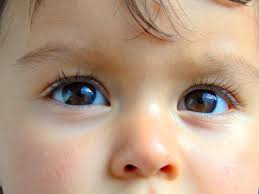
It is good for parents to know the stages of development of vision in a child, so that if they suspect that the child does not see properly or has a problem with the eyes (vision problems), they consult a specialist in time.
Vision problems must be ruled out when the child does not react appropriately to the environment. Most normal children show maturation of the various vision parameters at age stages. However, you parents should remember that no child is the same as any other child. The normal range of vision development varies. Children master developmental milestones at different ages.
Vision development - Newborn baby
Vision in a newborn baby is poorly developed. The baby is born with the senses of smell and touch predominant, so as to orient themselves to the familiar smell of the mother. Moreover these senses help the baby accept the mother's touch. Also, the newborn baby hears well, so as to respond to sudden, potentially dangerous sounds with worry, crying and an "appeal" for help whenever needed.
The newborn baby can see at a distance of about 30 centimetres. Closer or further, things become more blurred. The newborn baby has the ability to focus on the mother's face at a distance of about 30 centimetres. That is, the distance from the mother's breast to eye. Momentarily the baby may show that they follow with the eye an object moving slowly at this distance.
The eyelid-closing reflex works from birth, that is the infant blinks every time they are exposed to strong light or when we touch their eye. The eyes in a newborn at times are not well coordinated. They give the impression of squinting, but this will be told to you by the paediatrician.
Vision development - 1 month old newborn baby
The infant baby continues to see better at 30 centimetres, especially focusing on faces, images and details with strong contrasts between white and black. When receptive they can follow an object with their gaze by 90 degrees. They begin to produce tears.
Vision development - Baby 1-3 months
Until now the infant baby focused on details of an image and not on the whole. Now they begin to perceive, to look at the whole of an object or face. They are able to follow a light or face or object from one side to the other (180 degrees). Visual acuity improves gradually, so they see further. They begin to notice and gaze at their little hands.
Vision development - Baby 3-5 months
The infant baby looks at their hands. Visual acuity has improved a lot. The baby focuses at a more distant distance (metres). They recognise familiar faces, the mother's breast or the bottle. They look at themselves in the mirror. They begin to reach out their little hands to grab objects, which they try to bring to their mouth. Hand-eye cooperation begins. The baby hits a toy hanging in front of or above them.
Vision development - Baby 5-7 months
The infant baby now has a fuller development of visual acuity. They see colours fully, they look at greater distances. The baby develops preferences for specific colours, usually bright, red or orange. They turn their head to see an object. They touch their image in the mirror.
Vision development - Baby 7-11 months
The infant baby observes a small object with their eyes. They begin to have a sense of depth. They like the game of hiding and peek-a-boo. The baby has a greater ability to follow with their gaze an object that moves quickly.
Vision development - Baby 7-14 months
The infant baby places shapes into the appropriate holes of a box. They are interested in photographs and images in books. They recognise familiar objects or images in books. The baby points with their finger. They recognise their face in the mirror.
Vision development - Child up to 24 months
The child focuses on objects very close to or far from them. They make little lines with a pencil on paper. They may imitate a straight or circular line when we show them. They point with their finger at parts of the body if asked.
Vision development - Child up to 3 years
The child recognises some basic colours. Visual acuity is now almost perfect, like that of an adult, that is 20/20. If we draw something simple for a child they can copy it, mainly a circle or square.
Vision development - Child up to 6 years
By the time the child reaches primary school, their vision and hand-eye cooperation have fully developed. The child recognises numbers and letters. They are ready to learn to read. They have a full sense of perspective and depth in images, with objects near or far. They successfully use fine movements with scissors.
Source: paidiatros.com