


 Facebook
 Google
Treating amblyopia in a virtual reality environment using games
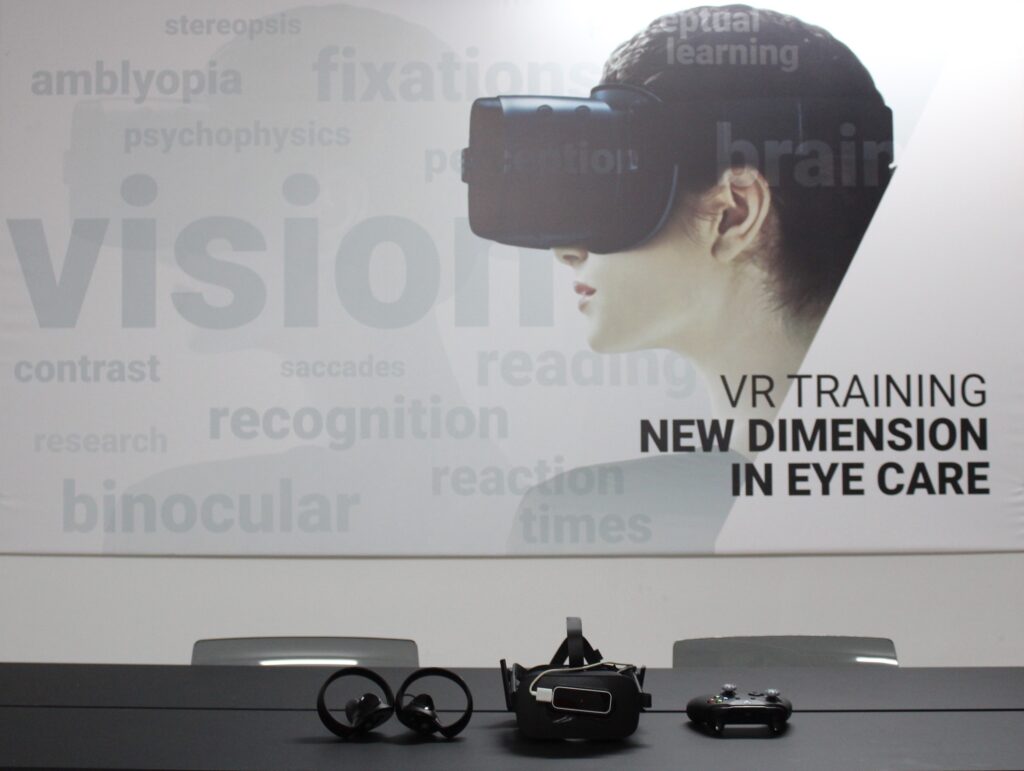
What is amblyopia? Vision develops gradually from birth until about the age of 10-12. To ensure clear vision, the refractive parts of the visual system need to form a clear image on the retina, the light-sensitive layer of the eye, and the brain needs to receive clear visual information from each eye. In the case where the neurons in the vision centres, especially during the years of vision development, do not receive the appropriate visual stimuli from one eye (e.g. due to refractive errors, strabismus, or juvenile cataract), then they show reduced stimulation, weaken and "become toneless", with the result that the eye shows reduced acuity. This condition is called amblyopia (amblys + ops) and is often described as a 'lazy eye', but incorrectly so, because in reality it is a neurological disorder. Amblyopia today is described, without doubt, as the most common cause of vision problems in childhood (2-5%). The main characteristic of amblyopia is recognised as the reduced acuity (visual acuity) in the affected eye, even when corrected with glasses or contact lenses. In reality, however, amblyopes have difficulty in several aspects of binocular vision, such as stereopsis (three-dimensional vision), the perception of depth and motion, the estimation of the distance between objects and the ability to estimate the trajectory of approaching objects. Also, the function of the oculomotor system is disturbed (e.g. fixation stability, accuracy and duration of saccadic movements), which affects important daily functional activities, especially those involving near work, such as reading. Management / treatment of amblyopia. The management of amblyopia initially includes the correction of possible refractive errors with glasses or contact lenses, which in some cases is enough to increase the visual acuity of the amblyopic eye. The use of prisms is also important in cases of strabismus, in order to ensure the alignment and fusion of the images from the two eyes, while an important role is also played by the practice and strengthening of binocular cooperation with various techniques, described as "vision training" exercises. The most widespread treatment of amblyopia is the method of covering the healthy (strong) eye for some hours a day in order for the brain to make use of the amblyopic eye. Occlusion therapy has been applied and has helped millions of patients worldwide in the management of amblyopia, usually with the simultaneous use of glasses where required. Nevertheless, it causes discomfort both to the child and to their family, as the patching may be necessary for more than 6 hours a day. A child with the good eye covered may have difficulty following lessons at school or is often unable to participate in games and activities. At the same time, intense psychological pressure is exerted on both the child and their parents, who must be in a constant struggle with them for the correct application of the treatment. The results of occlusion therapy, therefore, are not guaranteed: the majority of children show improvement in the visual acuity of their amblyopic eye (~80%), but only 30% of them will manage to reach a level approaching that of the healthy eye. Moreover, 25% of patients who had successful treatment in childhood are at risk of relapse within one year of stopping treatment, that is, their vision decreasing again. It is obvious that occlusion therapy cannot be applied at any age. When a child with amblyopia reaches the age of 9 to 10, they will begin to lose their ability to respond to covering the healthy eye and the improvement will become increasingly difficult and slow until the age of 12, when it will be minimised. Consequently, it is recommended to be applied at younger ages, where there is a high probability of response. "Vision training": Dichoptic exercise with the help of virtual reality devices. Until a few years ago it was considered that amblyopia, if not detected and treated in time, cannot be cured at older ages. In recent years, contrary to previous belief, research has shown that therapeutic techniques can also be effective in adult amblyopes, especially in cases of anisometropic amblyopia, that is, amblyopia due to a difference in myopia, hyperopia and astigmatism between the two eyes. These methods aim to strengthen binocular function, treating vision as a process for which the cooperation of both eyes is required. Indeed, the results seem to be even better when "training"/practice programmes of visual perception are combined with covering the healthy eye for some hours. "Vision training" programmes use dichoptic training techniques (Dichoptic Training), and have entered the field of amblyopia treatment dynamically in recent years, offering more benefits than conventional therapies. The software used for dichoptic training takes a virtual reality world and splits it into two images, projecting one to each eye, seeking the participation of both eyes through the fusion of the two images. It then reduces the brightness and contrast of the image of the "strong" eye so that the brain receives equivalent "visual" information from both eyes, allowing binocular fusion and integration. Thus, over time, the two eyes "learn" to cooperate and function simultaneously, while the help provided by the therapist and the programme becomes increasingly smaller. The new technology, with virtual reality devices, gives the patient the ability to be in a three-dimensional virtual reality environment, where they play games with the aim of improving their vision, ensuring higher compliance rates than occlusion therapy. Each patient has the ability to play games that help them move in space, improve eye-hand coordination, exercise their eye movements and the ability to track moving objects, and train their three-dimensional vision. The purpose of dichoptic training is to train the brain to use both eyes simultaneously, something that is not achieved with traditional therapies. By following a method that makes it necessary to use visual information from both eyes, the suppression of the amblyopic eye is lifted, the quality of vision of the amblyopic eye is improved and the way it functions resembles that of the "strong" eye. Also, the binocular functions of vision are trained, such as stereoscopic vision and a person's ability to see an object located behind an obstacle. Finally, it has been proven that dichoptic training can have beneficial effects on vision at older ages as well, compared to occlusion therapy, having helped even adult patients. In fact, in the case of adults, home treatment is also feasible, using a conventional virtual reality device and special software from the mobile phone. At Optical House we have had, since the beginning of 2019, a virtual reality device and the most internationally recognised dichoptic training software (Vivid Vision), for the vision training of children and adults with amblyopia within a 3D virtual reality environment with specially designed games. source: https://www.opticalhouse.gr/el/amblyopia-training/