


 Facebook
 Google
Interview with Stavros Kois in EYE MAGAZINE
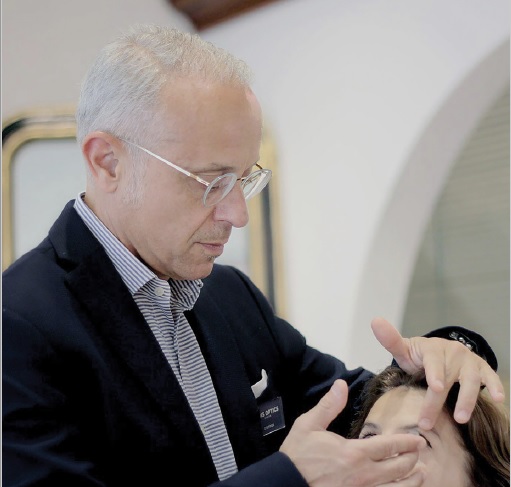
Presbyopia makes no distinctions. Anyone can show symptoms, whether they have worn glasses in the past for another condition or not. Instead of worrying about its onset, with the right information and diagnosis we can choose the ideal way to deal with it. Mr Stavros Kois, an optician who has run an optical store since 1984 in Ermoupoli, Syros, spoke to us about the right approach to presbyopia, the mistakes we usually make, and the new trends in prescription frames that can add a few "points" to our appearance.
Interview by Lina Theologitou, Journalist
What should we watch out for when buying a pair of reading glasses?
The right choice depends on many factors, such as age, profession, etc. A 38-year-old who has just begun to feel their eyes tiring needs different visual aids from a 50- or 60-year-old. A person who works many hours at a computer needs a different lens from a person who is, for example, a painter. The correct cooperation between ophthalmologist and optician, whether we are talking about contact lenses or lenses, can, I believe, lead the customer to the right decision and choice, so that we get the best possible result.
Presbyopia often appears in people who already have another eye condition, such as hyperopia, myopia or astigmatism. Are they forced to have two pairs of glasses?
In these cases, of course, we must find the right lens, which will contain the near, distance and intermediate ranges. This can also be done with contact lenses. Imagine there is a new multifocal lens that also corrects astigmatism. It is a very specialised case, but it is feasible. It is very pleasing that companies have advanced these two products a great deal (and they continue to evolve constantly), making our lives ever easier.
We often meet people with presbyopia who have bought glasses from kiosks or pharmacies, without first visiting an ophthalmologist. What is your comment on this?
Unfortunately, here in Greece even some vision specialists often recommend glasses from kiosks or pharmacies. This is a huge mistake because not only do they not help you get the right result, but they gradually damage your vision for distance as well. These glasses do not have the right lenses, do not account for the customer's centres and do not have the necessary filters. Most importantly, the right eye has a different presbyopia prescription from the left. I consider it unacceptable to do our shopping by chance. If we wear wrong glasses from the pharmacy or kiosk, our prescription will increase, meaning every year we need new numbers. Moreover, our distance vision will deteriorate. By wearing the right glasses, whether intermediate or multifocal, our presbyopia can stay stable for three to four years. What we should therefore do is first get the correct prescription from an ophthalmologist and then find the visual aid that is ideal for our case.
Many people do not wish to wear reading glasses, either for aesthetic or practical reasons.
It is natural that someone does not want to wear glasses that are not attractive, but fortunately the optical sector has evolved and very nice designs are now available. There are companies that have produced specialised glasses for near and intermediate distance, which are also fashion accessories. There are glasses that sit very nicely on the nose, in very beautiful colours and designs, and are quite light, so there is no reason why someone would not want them.
Having a long-standing presence in the optical sector, how do you see consumer needs having taken shape, and which characteristics does the customer focus on?
We observe that there is now demand for glasses that are affordable but also beautiful, and at the same time a need for glasses that are light — for example titanium frames. Titanium is a material that is very light and does not cause allergies on the nose, does not break, so whoever wears them feels safer and more comfortable. There is also considerable demand for some glasses that are very small and that one can even keep in a pocket. Fortunately, today there is a wealth of frames for all tastes, serving all needs.